 Tummi
TummiBowel diary: how to keep one, with a free template
A bowel diary, also called a stool diary or poop log, turns vague feelings into clear answers. It helps you see your own patterns, and it gives your doctor the facts they need in a short appointment. Here is what to write down, a free printable template and how an app can do it in two taps.
Why keep a bowel diary?
When you sit with a doctor about constipation, diarrhea or IBS, the questions are always similar: How often do you go? What does it look like? Since when? Does anything make it better or worse? What have you tried? Hardly anyone can answer that from memory. A diary can.
For IBS, the NHS recommends keeping a diary of what you eat and any symptoms you get, to find your personal triggers. Gastroenterology clinics, continence services and children's hospitals often hand out their own bowel diaries for the same reason. If your clinic gives you one, use theirs.
What to record in a stool diary
Start small. Time and Bristol type are enough to learn a lot. Add more only if it helps answer your question.
| Entry | Why it helps | Example |
|---|---|---|
| Date and time | Shows your rhythm and gaps. | Tue 07:40 |
| Bristol type (1 to 7) | The standard way to describe shape. See the Bristol stool chart. | Type 2 |
| Colour | Spots black, red or pale stool early. See poop colour meaning. | Brown |
| Urgency, straining, unfinished feeling | Typical questions for constipation and IBS. | Strained a lot |
| Pain, bloating, gas | Shows how much symptoms affect you. | Cramps 4 of 10 |
| Blood or mucus | Always worth mentioning to a doctor. | None |
| Food and drinks | Helps find patterns after meals. | Lentil curry, 2 coffees |
| Water and fiber | Often the first thing to adjust. | 1.5 litres, psyllium 5 g |
| Laxatives and medicines | Shows what you tried and how long it took to work. | Macrogol at 21:00 |
| Period, sleep, stress | All of these can shift your gut. | Day 2 of period |
How to keep it without it becoming a chore
- Log right after the toilet. It takes ten seconds then, and it is guesswork an hour later.
- Keep two weeks as a minimum. Two weeks show your rhythm. For food patterns and IBS, four weeks or more give a clearer picture.
- Write down the days without, too. A gap is information, especially with constipation.
- Do not change everything at once. If you add fiber, more water and a new laxative in the same week, you will not know what helped.
- Be kind to yourself. Missing a day is fine. Just continue.
How to read your diary after two weeks
- Count per week. Fewer than three bowel movements a week counts as constipation in common definitions. See how often you should poop.
- Look at your Bristol mix. Mostly 1 and 2, mostly 3 to 5, or a lot of 6 and 7? Or a mix of hard and loose days?
- Check what you tried. Did more water and fiber shift things after a week or two? How long did a laxative take?
- Look for repeats, not single days. One bad day after pizza proves nothing. The same reaction four times is worth discussing.
- Note warning signs separately. Blood, black or pale stool, weight loss or pain at night belong in front of a doctor, not in a spreadsheet.
Paper or app?
Both work. Paper is simple, free and needs no phone. An app adds the things paper cannot do: exact times, a counter since your last bowel movement, charts, reminders and a tidy summary you can share. Whatever you choose, the best diary is the one you actually keep.
How Tummi works as a poop tracker app
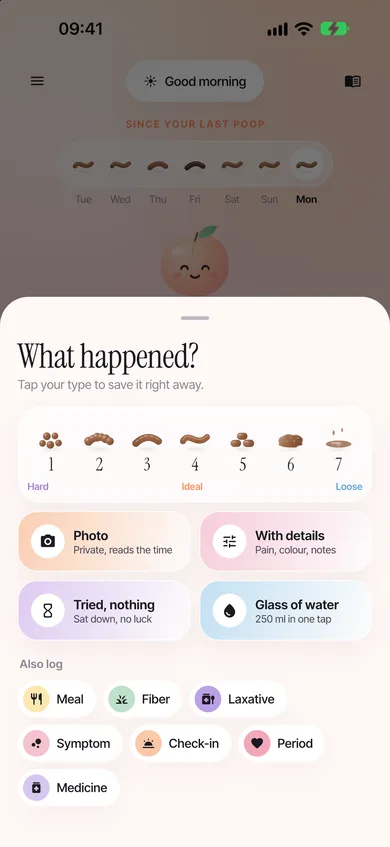
- Two taps: pick a Bristol type and you are done. Colour, amount, urgency, straining, pain, blood, mucus, a note or a photo are optional.
- Food, water, fiber, laxatives, symptoms and period in the same diary.
- Private by design: no account, entries stay on your iPhone with a backup in your own iCloud, photos stay inside the app behind Face ID.
- Free: logging, calendar, full history, reminders, CSV export and backups.
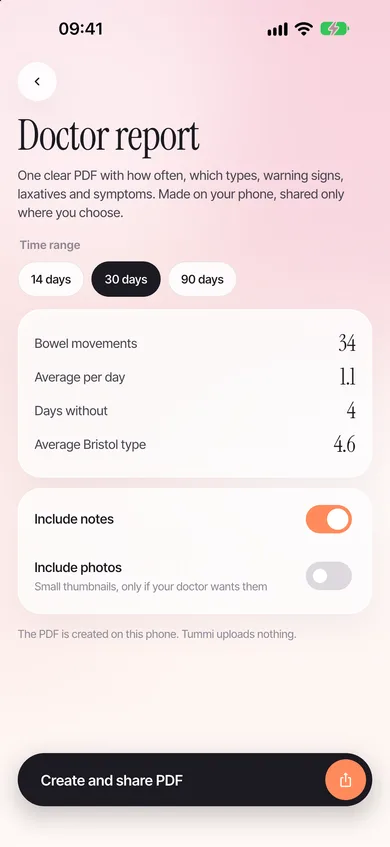
- Tummi Plus: charts, patterns after meals and a PDF report for your doctor.
Frequently asked questions
How long should I keep a bowel diary?
Two weeks is a good start and shows your rhythm. For food patterns or IBS, four weeks or more give a clearer picture. If your doctor asks for a specific period, follow that.
What is the difference between a bowel diary and a stool diary?
None. Bowel diary, stool diary, poop log and poop tracker all mean the same thing: a record of your bowel movements, usually with the Bristol type.
Is there a free printable bowel diary?
Yes. You can download our free bowel diary template as a PDF. It covers two weeks and has the Bristol types printed on top.
Is there a free poop tracker app?
Tummi is free to use for logging, the calendar, your full history, reminders, CSV export and backups. Charts, meal patterns and the doctor report are part of the optional Tummi Plus.
Can I share my bowel diary with my doctor?
Yes. With paper, just bring it. In Tummi you can export a CSV file for free, and with Tummi Plus create a one page PDF report.
Sources
Related guides
 Bristol stool chart
What each of the seven poop types means, which ones are normal and a free printable chart.
Bristol stool chart
What each of the seven poop types means, which ones are normal and a free printable chart.
 IBS food diary
What to log, the five FODMAP groups and how to read patterns after meals honestly.
IBS food diary
What to log, the five FODMAP groups and how to read patterns after meals honestly.
 How often should you poop?
From three times a day to three times a week: what is normal and what changes your rhythm.
How often should you poop?
From three times a day to three times a week: what is normal and what changes your rhythm.